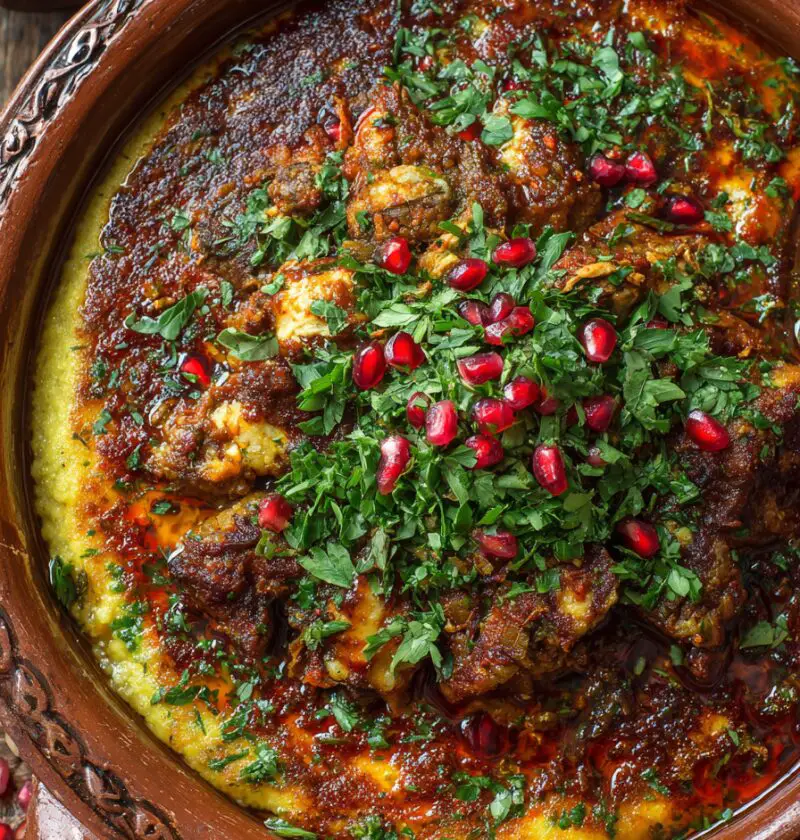
Persian Recipe: Fragrant Herb Rice with Golden Tahdig (My Go‑To Persian Comfort Dish)
If you’ve been craving a Persian recipe that’s both comforting and a little bit glamorous, this Persian herb rice with golden tahdig is your new weeknight–meets–special-occasion star.
I’m a 50-year-old home cook who’s been obsessed with Persian cuisine since my college roommate’s mother sent us back to campus with a giant pot of Persian rice and stew. This dish is my love letter to that memory: fluffy, fragrant basmati rice layered with Persian herbs, a hint of Persian saffron, and a crisp, golden tahdig crust that honestly makes the whole table go quiet for a second.
It’s healthy, it’s naturally gluten-free, it pairs beautifully with Persian lamb, Persian chicken, Persian kebab, or just a bowl of garlicky Persian yogurt—and it’ll make your kitchen smell like a cozy little restaurant in Tehran.
Full Recipe Introduction: What Makes This Persian Recipe So Special?
This Persian recipe is a classic sabzi polo–style herb rice with tahdig: long-grain rice parboiled, then steamed with fresh and dried herbs like dill, parsley, cilantro, and chives. The showstopper is the tahdig—the deeply golden, crunchy crust at the bottom of the pot that Persians treat like treasure.
You’ll find versions of this Persian herb rice served for Nowruz (Persian New Year) alongside fish, but around my house in the U.S., it shows up with everything from roasted Persian eggplant to a simple Persian salad of cucumbers, tomatoes, and herbs. It works on a busy Tuesday, but it also feels right at home on a holiday table with a slow-cooked Persian stew or a jewel-toned Persian pomegranate chicken.
Why do I love this recipe so much?
- It uses basic pantry ingredients plus a few classic Persian spices.
- It sneaks in a big handful of herbs, so it’s both aromatic and nutrient-rich.
- It’s naturally vegetarian and gluten-free, but you can serve it with anything—Persian lamb shanks, kebabs, grilled chicken, even salmon.
- It reheats well and tastes even better the next day.
And if you’ve ever been intimidated by Persian pilaf or worried about messing up Persian tahdig, stay with me. I’ll walk you through exactly what to look, smell, and listen for so you can get that gorgeous crust every time.
Why You’ll Love This Persian Recipe
- Crispy tahdig every time – Step-by-step cues make that famous Persian tahdig way less scary.
- Fluffy, separate grains of rice – No mush here; this is restaurant-style Persian rice in your own kitchen.
- Packed with fresh herbs – Dill, cilantro, parsley, and chives turn this into a gentle “green” powerhouse.
- Pairs with everything – From Persian stew to grilled fish, Persian kebab, or roasted vegetables.
- Naturally gluten-free and flexible – Easy to keep vegetarian or load up with Persian chicken or lamb on the side.
- Simple ingredients, big flavor – Just rice, herbs, a touch of Persian saffron, and pantry fats.
- Make-ahead friendly – You can parboil the rice ahead, then steam and crisp when it’s almost dinnertime.
- Impressive but approachable – Looks like a special-occasion Persian dish, cooks like a weeknight staple.
- Kid- and crowd-friendly – Mild in flavor, but layered with enough Persian spices to keep adults happy.
Ingredients
For this Persian herb rice with tahdig, you’ll need:
- 2 cups long-grain basmati rice (look for aged basmati; it stays fluffy and aromatic)
- 3 tablespoons kosher salt, divided (1½ tablespoons for salting the boiling water, 1½ teaspoons for seasoning the rice)
- 6 cups water, plus more for rinsing
- 1 cup finely chopped fresh parsley (flat-leaf works best; avoid thick stems)
- 1 cup finely chopped fresh cilantro
- 1 cup finely chopped fresh dill (fronds only for better texture)
- ½ cup finely chopped fresh chives or green onions (green parts only)
- ¼ cup neutral oil (sunflower, grapeseed, or canola)
- 3 tablespoons unsalted butter (or ghee for a richer, nutty flavor)
- ¼ teaspoon ground saffron threads, loosely packed (or a good pinch of saffron threads)
- 3 tablespoons hot water (for blooming the saffron)
- ½ teaspoon ground turmeric (optional, but helps color and flavor the tahdig)
- ½ teaspoon ground black pepper
- 1 cup plain Persian yogurt or whole-milk Greek yogurt (for an extra-crispy yogurt tahdig—optional but highly recommended)
Optional garnishes (for a restaurant-style touch):
- ¼ cup lightly toasted slivered almonds or pistachios
- ¼ cup golden raisins or barberries (zereshk), lightly sautéed in a teaspoon of butter
- Extra fresh herbs, finely chopped
A few quick notes:
- Use whole-milk yogurt for the tahdig layer—it has enough fat to brown nicely without burning.
- If you can, use real Persian saffron (from a trusted brand like Sadaf or Mehr Saffron). It’s pricier, but a little goes a long way and the flavor is deeper and more floral than cheaper blends.
- Dried dill can be added if you’re short on fresh dill; use about 1–2 tablespoons of dried dill in addition to or instead of some of the fresh.
Directions
-
Rinse the rice until the water runs almost clear
Add the basmati rice to a large bowl, cover with cool water, and gently swish with your fingertips. Drain and repeat 4–5 times until the water looks mostly clear. This step removes excess starch and gives you that classic, fluffy Persian rice. -
Soak the rice with salt
Cover the rinsed rice with lukewarm water by about 2 inches and stir in 1 tablespoon of kosher salt. Let it soak for at least 30 minutes (up to 2 hours). Soaking helps the grains cook more evenly and lengthen slightly—that signature Persian pilaf look. -
Prep the saffron “tea”
In a small cup, crush the saffron with the back of a spoon or between your fingers. Pour 3 tablespoons of hot (not boiling) water over it and let it sit. This blooming step pulls out the color and aroma, turning the water a gorgeous deep orange-gold. -
Chop the herbs finely but not into paste
While the rice soaks, chop your parsley, cilantro, dill, and chives. You want fine pieces so they distribute nicely, but don’t overdo it—you’re not making a pesto. A sharp chef’s knife works better than a food processor, which can bruise the herbs and make them watery. -
Parboil the rice until it’s “al dente”
Bring 6 cups of water to a boil in a large pot. Add 1½ tablespoons of kosher salt. Drain the soaked rice and gently pour it into the boiling water. Stir once to prevent clumping. Boil for about 6–8 minutes, tasting after 5 minutes. The grains should be soft at the edges but still firm in the center—like pasta before it’s fully done. -
Drain and rinse with warm water
When the rice is just shy of done, pour it into a large colander set in the sink. Rinse with warm water (not cold) to remove excess surface starch and stop the cooking without shocking the grains. Let it drain well for a couple of minutes. -
Mix the rice with herbs and spices
Transfer the drained rice to a large bowl. Gently toss in the chopped herbs, black pepper, and the remaining 1½ teaspoons of salt (adjust to taste—remember it should taste pleasantly seasoned). Try not to break the grains; use a light hand, like you’re folding whipped cream. -
Get the tahdig mixture ready
In a small bowl, whisk together ½ cup of the herbed rice with the yogurt, turmeric, 2 tablespoons of the oil, and 1 tablespoon of the saffron water. This will be your tahdig base—thicker and richer so it crisps up beautifully at the bottom of the pot. -
Heat the pot and form the tahdig layer
Use a heavy-bottomed nonstick or enameled Dutch oven (9–10 inches wide works great). Add the remaining 2 tablespoons of oil and 3 tablespoons of butter. Heat over medium until the butter melts and just starts to foam. Swirl it around to coat the base. Spread the yogurt-rice mixture in an even layer over the bottom of the pot—press gently with the back of a spoon. -
Mound the herbed rice into a gentle pyramid
Spoon the remaining herbed rice over the tahdig layer, building it up into a loose mound. Don’t press too hard; you want steam to move through the rice. Use the handle of a wooden spoon to poke 4–5 small holes down through the rice to the bottom—these steam “chimneys” help cook the rice evenly. -
Steam the rice—first on medium, then low
Drizzle the rest of the saffron water over the top of the rice. Wrap the pot lid in a clean kitchen towel (tie or clip the ends so they don’t dangle near the burner) and cover the pot. Cook over medium heat for 10 minutes; you should hear a gentle sizzle as the tahdig begins to form. Then reduce the heat to low and cook for 30–35 minutes, letting the rice steam and the crust turn golden. -
Check for doneness and tahdig crispness
After 30 minutes on low, you should smell a toasty, nutty aroma. That’s your cue. You can gently lift one edge with a thin spatula to peek at the tahdig—it should be deep golden and crisp but not burnt. If it’s still pale, leave it another 5–10 minutes. Patience really pays here. -
Rest the rice before flipping
Turn off the heat and let the pot sit for 5 minutes with the lid on. This rest helps the tahdig release more easily and keeps the rice tender and fluffy. -
The big reveal: unmold or serve in two stages
You’ve got two options:- For a dramatic presentation, place a large platter over the pot and carefully flip the whole thing (wear good oven mitts). Lift the pot straight up to reveal a “cake” of Persian herb rice with tahdig on top.
- Or, more forgivingly, scoop most of the rice gently into a serving bowl, then slide or lift the tahdig out in large pieces and arrange on top.
-
Garnish and serve
Sprinkle with toasted nuts, sautéed barberries or raisins, and extra fresh herbs if you like. Serve hot with Persian yogurt, cucumber yogurt salad (mast-o-khiar), a bright Persian salad, and your favorite Persian stew, Persian lamb, or Persian chicken dish.
Servings & Timing
- Yield: Serves 6–8 as a side dish, 4–5 as a main with salad and yogurt
- Prep Time: 25 minutes active prep (chopping herbs, rinsing and soaking rice)
- Rest/Soak Time: 30–120 minutes for soaking rice (hands-off)
- Cook Time: 45–55 minutes (including parboiling and steaming)
- Total Time: About 1½–2 hours (most of that is gentle simmering and soaking while you do other things)
Variations
- Garlic & Herb Persian Rice – Add 3–4 cloves of minced garlic to the butter and oil before adding the tahdig layer for a gentle garlicky aroma.
- Persian Pomegranate Rice – Fold in ½ cup fresh pomegranate arils and a drizzle of pomegranate molasses right before serving for sweet-tart pops of flavor.
- Spiced Persian Pilaf – Stir ½ teaspoon each of ground cumin and coriander into the herb mixture to echo the flavors of many Persian stews.
- Vegetable-Stuffed Herb Rice – Fold in 1 cup of finely diced sautéed carrots, peas, and green beans for a colorful, veggie-rich side.
- Crispy Potato Tahdig – Skip the yogurt mix and layer thin slices of potato (tossed with turmeric and salt) on the bottom of the pot for a potato tahdig instead.
- Saffron Chicken Herb Rice – Nestle small bone-in chicken thighs, marinated in yogurt and saffron, into the rice mound before steaming for a one-pot Persian chicken meal.
Storage & Reheating
- Storing: Cool leftovers to room temperature, then store in an airtight container in the fridge for up to 4 days. Keep tahdig pieces on top so they’re easier to re-crisp.
- Freezing: Persian herb rice freezes fairly well—up to 2 months. Spread it in a thin layer in a freezer bag, press out excess air, label, and freeze. Tahdig loses some crunch but still tastes great.
- Reheating on the stove: For the best texture, warm a nonstick skillet with a teaspoon of oil over medium-low heat. Add rice and tahdig, cover, and heat gently until hot, letting the tahdig re-crisp.
- Reheating in the microwave: Place rice in a microwave-safe bowl, sprinkle with a teaspoon of water, cover with a damp paper towel, and warm in 30–45 second bursts, fluffing between rounds.
- Make-ahead tip: You can parboil and drain the rice up to 8 hours ahead. Toss with a little oil to prevent sticking, refrigerate, and then steam with herbs and tahdig just before serving.
Notes (Little Lessons from My Kitchen)
- Salt the water generously. Persian rice should be well-seasoned, and most of that flavor starts in the boiling water. If the water tastes mildly like the sea, you’re in the right place.
- Don’t rush the tahdig. Every time I got impatient and turned the heat up, I regretted it with a burnt patch. Medium to start, then low and slow—the crust needs time, not aggression.
- Use your senses. You’ll hear a gentle, steady sizzle during steaming and then a slightly sharper crackle as the tahdig sets. The smell will shift from plain butter to nutty and toasty. Those are your best cues.
- Herbs shrink, so be generous. A huge pile of chopped herbs will cook down, leaving you with a beautifully speckled green-and-white Persian herb rice. Don’t be shy.
- Nonstick or enameled pots are your friends. Traditional Persian cooks use well-seasoned pots; for most of us, a good nonstick Dutch oven or heavy skillet makes tahdig success much more likely.
- Play with pairings. This Persian recipe is a natural partner to Persian stew (khoresh), but it’s also gorgeous with grilled salmon, roasted eggplant, or even a simple tomato and cucumber Persian salad.
FAQs
1. What makes this Persian recipe different from regular rice?
Persian rice is parboiled, then steamed with herbs and saffron, and finished with a crisp tahdig crust—so you get fluffy grains, layers of Persian herbs, and that addictive crunchy bottom layer.
2. Do I have to use saffron?
Technically no, but saffron is a signature Persian spice and adds a floral, earthy, slightly sweet aroma that’s hard to mimic; if you skip it, you can add a bit of turmeric for color, but the flavor won’t be quite the same.
3. Can I use brown rice?
You can, but the texture and timing change a lot. Brown rice needs a longer parboil and more steaming time, and it won’t be as light and fluffy as traditional Persian basmati rice.
4. My tahdig burned—what went wrong?
Most likely the heat was too high or it cooked too long without enough fat. Next time, start on medium just until you hear a gentle sizzle, then turn it down to low and don’t skimp on the oil and butter (or ghee).
5. How do I keep the rice from getting mushy?
Rinse well to remove starch, don’t skip the soaking, and parboil only until the rice is firm in the center—remember it will finish cooking during the steaming phase.
6. Can I make this Persian recipe dairy-free?
Yes—use oil or dairy-free butter instead of butter, and skip the yogurt tahdig. Make a simple oil-based tahdig with rice and turmeric, or try a potato tahdig for a fully dairy-free version.
7. What should I serve with Persian herb rice?
It’s fantastic with Persian lamb shanks, saffron Persian chicken, grilled Persian kebab, or a hearty Persian soup and a creamy bowl of Persian yogurt with cucumbers and mint.
8. Can I add vegetables or protein directly into the rice?
Absolutely. Lightly sautéed vegetables, chickpeas, or small marinated chicken pieces can be tucked into the rice mound before steaming for a more complete one-pot meal.
Conclusion
This Persian recipe for herb rice with golden tahdig is one of those dishes that feels both deeply comforting and quietly impressive. You get the fragrance of Persian herbs, the warmth of Persian saffron, and that shattering crunch of tahdig—all from a simple pot of rice.
If you try this Persian herb rice, I’d truly love to hear how it goes—tell me in the comments what you served it with, or whether your family fought over the tahdig like mine does. And if you’re ready for a full Persian feast, this pairs beautifully with a slow-simmered Persian stew, a juicy Persian kebab, or a bright Persian salad for balance.
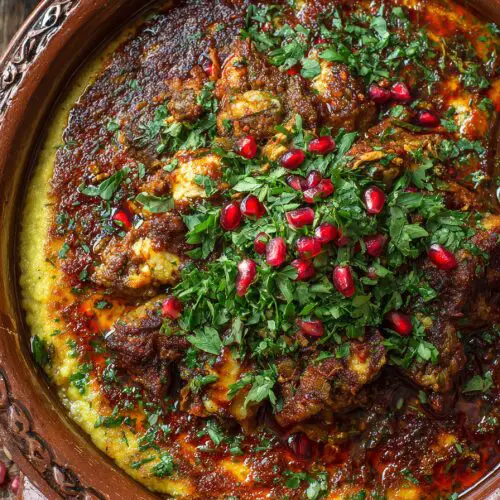
Persian Herb Rice with Golden Tahdig
Ingredients
- 2 cups long-grain basmati rice preferably aged
- 3 tablespoons kosher salt divided; 1½ tablespoons for boiling water, 1½ teaspoons for seasoning rice, plus 1 tablespoon for soaking water
- 6 cups water plus more for rinsing and soaking
- 1 cup fresh parsley finely chopped, flat-leaf, thick stems removed
- 1 cup fresh cilantro finely chopped
- 1 cup fresh dill finely chopped, fronds only
- 1/2 cup fresh chives or green onions finely chopped, green parts only
- 1/4 cup neutral oil such as sunflower, grapeseed, or canola
- 3 tablespoons unsalted butter or ghee for a richer flavor
- 1/4 teaspoon saffron threads lightly ground; or a generous pinch of threads
- 3 tablespoons hot water for blooming saffron
- 1/2 teaspoon ground turmeric optional, for color and flavor in tahdig
- 1/2 teaspoon ground black pepper
- 1 cup plain whole-milk yogurt Persian or Greek; for yogurt tahdig (optional but recommended)
- 1/4 cup slivered almonds or pistachios lightly toasted, optional garnish
- 1/4 cup golden raisins or barberries (zereshk) lightly sautéed in 1 teaspoon butter, optional garnish
- extra fresh herbs finely chopped, for garnish (optional)
Instructions
- Add the basmati rice to a large bowl, cover with cool water, and gently swish with your fingertips. Drain and repeat 4–5 times, until the water runs almost clear to remove excess starch.2 cups long-grain basmati rice, 6 cups water
- Cover the rinsed rice with lukewarm water by about 2 inches and stir in about 1 tablespoon of kosher salt. Let soak for at least 30 minutes and up to 2 hours so the grains hydrate and cook more evenly.2 cups long-grain basmati rice, 3 tablespoons kosher salt, 6 cups water
- In a small cup, lightly crush the saffron threads, then pour 3 tablespoons of hot (not boiling) water over them. Let sit to bloom until the water turns deep orange-gold and aromatic.1/4 teaspoon saffron threads, 3 tablespoons hot water
- While the rice soaks, finely chop the parsley, cilantro, dill, and chives or green onions. Aim for fine pieces without turning the herbs into a paste so they stay fresh and distinct in the rice.1 cup fresh parsley, 1 cup fresh cilantro, 1 cup fresh dill, 1/2 cup fresh chives or green onions
- Bring 6 cups of water to a boil in a large pot and add 1½ tablespoons of kosher salt. Drain the soaked rice and gently add it to the boiling water. Stir once to prevent clumping and boil for 6–8 minutes, tasting after 5 minutes. The grains should be soft at the edges but still firm in the center.2 cups long-grain basmati rice, 3 tablespoons kosher salt, 6 cups water
- Pour the parboiled rice into a large colander set in the sink. Rinse briefly with warm water to remove excess surface starch and stop the cooking without shocking the grains. Let drain well for a couple of minutes.2 cups long-grain basmati rice, 6 cups water
- Transfer the drained rice to a large bowl. Gently fold in the chopped herbs, black pepper, and about 1½ teaspoons of kosher salt (adjust to taste). Toss lightly to avoid breaking the grains.2 cups long-grain basmati rice, 3 tablespoons kosher salt, 1 cup fresh parsley, 1 cup fresh cilantro, 1 cup fresh dill, 1/2 cup fresh chives or green onions, 1/2 teaspoon ground black pepper
- In a small bowl, mix about 1/2 cup of the herbed rice with the yogurt, turmeric, 2 tablespoons of the neutral oil, and 1 tablespoon of the saffron water. Stir until evenly combined; this rich mixture will form the crispy tahdig layer.2 cups long-grain basmati rice, 1 cup fresh parsley, 1 cup fresh cilantro, 1 cup fresh dill, 1/2 cup fresh chives or green onions, 1/4 cup neutral oil, 1/4 teaspoon saffron threads, 3 tablespoons hot water, 1/2 teaspoon ground turmeric, 1 cup plain whole-milk yogurt
- Use a heavy-bottomed nonstick or enameled Dutch oven (about 9–10 inches wide). Add the remaining 2 tablespoons neutral oil and the butter. Heat over medium until the butter melts and just begins to foam, swirling to coat the base. Spread the yogurt-rice mixture evenly over the bottom of the pot, pressing gently with the back of a spoon to form a compact layer.1/4 cup neutral oil, 3 tablespoons unsalted butter, 1 cup plain whole-milk yogurt
- Spoon the remaining herbed rice over the tahdig layer, building it into a loose mound. Do not press down firmly; you want space for steam to circulate. Use the handle of a wooden spoon to poke 4–5 holes down through the rice to the bottom of the pot to act as steam vents.2 cups long-grain basmati rice, 1 cup fresh parsley, 1 cup fresh cilantro, 1 cup fresh dill, 1/2 cup fresh chives or green onions
- Drizzle the remaining saffron water over the top of the rice. Wrap the pot lid in a clean kitchen towel (securing the ends so they don’t touch the burner) and cover the pot. Cook over medium heat for about 10 minutes, until you hear a gentle sizzle as the tahdig begins to form. Reduce the heat to low and continue cooking for 30–35 minutes, allowing the rice to steam and the crust to turn golden.1/4 teaspoon saffron threads, 3 tablespoons hot water
- After about 30 minutes on low, you should smell a toasty, nutty aroma. Gently slide a thin spatula down one side to peek at the tahdig; it should be deep golden and crisp but not burned. If it is still pale, continue cooking for another 5–10 minutes on low.
- Turn off the heat and let the pot rest, covered, for 5 minutes. This helps the tahdig release more easily and keeps the rice fluffy.
- For a dramatic presentation, place a large platter over the pot and carefully invert the pot and platter together, then lift off the pot to reveal the rice with tahdig on top. Alternatively, gently spoon most of the rice into a serving dish, then loosen and lift the tahdig out in large pieces and arrange on top.
- Garnish the rice with toasted nuts, sautéed barberries or raisins, and extra chopped fresh herbs if desired. Serve hot with yogurt, salad, and your choice of Persian stew, lamb, chicken, kebab, or roasted vegetables.1/4 cup slivered almonds or pistachios, 1/4 cup golden raisins or barberries (zereshk), extra fresh herbs