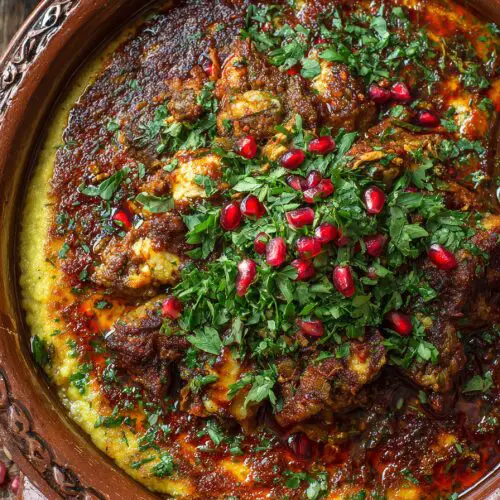
Persian Herb Rice with Golden Tahdig
Classic sabzi polo–style Persian herb rice with a deeply golden, crispy tahdig crust. Fluffy basmati rice is steamed with fresh herbs and saffron for a dish that works for both weeknights and special occasions.
Ingredients
- 2 cups long-grain basmati rice preferably aged
- 3 tablespoons kosher salt divided; 1½ tablespoons for boiling water, 1½ teaspoons for seasoning rice, plus 1 tablespoon for soaking water
- 6 cups water plus more for rinsing and soaking
- 1 cup fresh parsley finely chopped, flat-leaf, thick stems removed
- 1 cup fresh cilantro finely chopped
- 1 cup fresh dill finely chopped, fronds only
- 1/2 cup fresh chives or green onions finely chopped, green parts only
- 1/4 cup neutral oil such as sunflower, grapeseed, or canola
- 3 tablespoons unsalted butter or ghee for a richer flavor
- 1/4 teaspoon saffron threads lightly ground; or a generous pinch of threads
- 3 tablespoons hot water for blooming saffron
- 1/2 teaspoon ground turmeric optional, for color and flavor in tahdig
- 1/2 teaspoon ground black pepper
- 1 cup plain whole-milk yogurt Persian or Greek; for yogurt tahdig (optional but recommended)
- 1/4 cup slivered almonds or pistachios lightly toasted, optional garnish
- 1/4 cup golden raisins or barberries (zereshk) lightly sautéed in 1 teaspoon butter, optional garnish
- extra fresh herbs finely chopped, for garnish (optional)
Instructions
- Add the basmati rice to a large bowl, cover with cool water, and gently swish with your fingertips. Drain and repeat 4–5 times, until the water runs almost clear to remove excess starch.2 cups long-grain basmati rice, 6 cups water
- Cover the rinsed rice with lukewarm water by about 2 inches and stir in about 1 tablespoon of kosher salt. Let soak for at least 30 minutes and up to 2 hours so the grains hydrate and cook more evenly.2 cups long-grain basmati rice, 3 tablespoons kosher salt, 6 cups water
- In a small cup, lightly crush the saffron threads, then pour 3 tablespoons of hot (not boiling) water over them. Let sit to bloom until the water turns deep orange-gold and aromatic.1/4 teaspoon saffron threads, 3 tablespoons hot water
- While the rice soaks, finely chop the parsley, cilantro, dill, and chives or green onions. Aim for fine pieces without turning the herbs into a paste so they stay fresh and distinct in the rice.1 cup fresh parsley, 1 cup fresh cilantro, 1 cup fresh dill, 1/2 cup fresh chives or green onions
- Bring 6 cups of water to a boil in a large pot and add 1½ tablespoons of kosher salt. Drain the soaked rice and gently add it to the boiling water. Stir once to prevent clumping and boil for 6–8 minutes, tasting after 5 minutes. The grains should be soft at the edges but still firm in the center.2 cups long-grain basmati rice, 3 tablespoons kosher salt, 6 cups water
- Pour the parboiled rice into a large colander set in the sink. Rinse briefly with warm water to remove excess surface starch and stop the cooking without shocking the grains. Let drain well for a couple of minutes.2 cups long-grain basmati rice, 6 cups water
- Transfer the drained rice to a large bowl. Gently fold in the chopped herbs, black pepper, and about 1½ teaspoons of kosher salt (adjust to taste). Toss lightly to avoid breaking the grains.2 cups long-grain basmati rice, 3 tablespoons kosher salt, 1 cup fresh parsley, 1 cup fresh cilantro, 1 cup fresh dill, 1/2 cup fresh chives or green onions, 1/2 teaspoon ground black pepper
- In a small bowl, mix about 1/2 cup of the herbed rice with the yogurt, turmeric, 2 tablespoons of the neutral oil, and 1 tablespoon of the saffron water. Stir until evenly combined; this rich mixture will form the crispy tahdig layer.2 cups long-grain basmati rice, 1 cup fresh parsley, 1 cup fresh cilantro, 1 cup fresh dill, 1/2 cup fresh chives or green onions, 1/4 cup neutral oil, 1/4 teaspoon saffron threads, 3 tablespoons hot water, 1/2 teaspoon ground turmeric, 1 cup plain whole-milk yogurt
- Use a heavy-bottomed nonstick or enameled Dutch oven (about 9–10 inches wide). Add the remaining 2 tablespoons neutral oil and the butter. Heat over medium until the butter melts and just begins to foam, swirling to coat the base. Spread the yogurt-rice mixture evenly over the bottom of the pot, pressing gently with the back of a spoon to form a compact layer.1/4 cup neutral oil, 3 tablespoons unsalted butter, 1 cup plain whole-milk yogurt
- Spoon the remaining herbed rice over the tahdig layer, building it into a loose mound. Do not press down firmly; you want space for steam to circulate. Use the handle of a wooden spoon to poke 4–5 holes down through the rice to the bottom of the pot to act as steam vents.2 cups long-grain basmati rice, 1 cup fresh parsley, 1 cup fresh cilantro, 1 cup fresh dill, 1/2 cup fresh chives or green onions
- Drizzle the remaining saffron water over the top of the rice. Wrap the pot lid in a clean kitchen towel (securing the ends so they don’t touch the burner) and cover the pot. Cook over medium heat for about 10 minutes, until you hear a gentle sizzle as the tahdig begins to form. Reduce the heat to low and continue cooking for 30–35 minutes, allowing the rice to steam and the crust to turn golden.1/4 teaspoon saffron threads, 3 tablespoons hot water
- After about 30 minutes on low, you should smell a toasty, nutty aroma. Gently slide a thin spatula down one side to peek at the tahdig; it should be deep golden and crisp but not burned. If it is still pale, continue cooking for another 5–10 minutes on low.
- Turn off the heat and let the pot rest, covered, for 5 minutes. This helps the tahdig release more easily and keeps the rice fluffy.
- For a dramatic presentation, place a large platter over the pot and carefully invert the pot and platter together, then lift off the pot to reveal the rice with tahdig on top. Alternatively, gently spoon most of the rice into a serving dish, then loosen and lift the tahdig out in large pieces and arrange on top.
- Garnish the rice with toasted nuts, sautéed barberries or raisins, and extra chopped fresh herbs if desired. Serve hot with yogurt, salad, and your choice of Persian stew, lamb, chicken, kebab, or roasted vegetables.1/4 cup slivered almonds or pistachios, 1/4 cup golden raisins or barberries (zereshk), extra fresh herbs
Notes
Use generously salted water when parboiling the rice so the grains are well seasoned. Don’t rush the tahdig: start on medium heat only long enough to build gentle sizzle, then cook low and slow until deeply golden. A nonstick or enameled heavy pot greatly increases your chances of getting an intact, crispy crust. Herbs shrink during cooking, so err on the side of plenty for a vibrant green-and-white rice. The rice can be parboiled up to 8 hours ahead, then steamed with herbs and tahdig just before serving.
Nutrition
Calories: 320kcal
Love this recipe?Follow us at @thenandnowspace for more