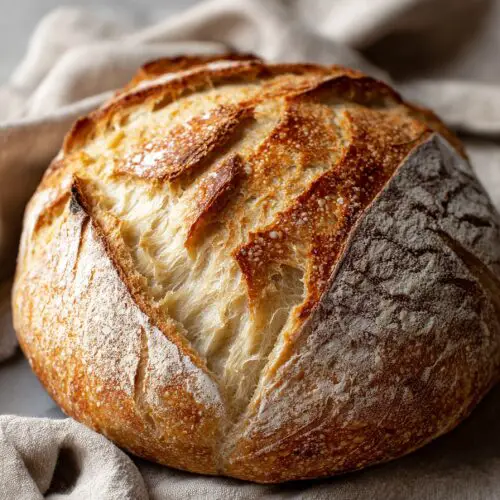
Same Day Sourdough Bread (No Overnight Wait)
A rustic, crusty same-day sourdough loaf with a chewy crumb and gentle tang, made start-to-finish in about 6–8 hours using an active starter, warm fermentation, and simple stretch-and-folds instead of kneading.
Ingredients
- 150 g active sourdough starter 100% hydration, bubbly and doubled, passes float test
- 325 g warm water about 80–85°F (lukewarm; slightly cooler in a warm kitchen)
- 450 g bread flour or 400 g bread flour + 50 g whole wheat flour
- 9 g fine sea salt about 1 1/2 teaspoons
- 10 g olive oil about 2 teaspoons; optional, for softer crumb and easier handling
- rice flour or all-purpose flour for dusting the banneton or towel
Instructions
- In a large bowl, whisk together the 150 g active sourdough starter and 325 g warm water until the starter is mostly dissolved and the mixture looks milky. This distributes the wild yeast evenly for faster, even fermentation.150 g active sourdough starter, 325 g warm water
- Stir in the 450 g flour with a sturdy spoon or dough whisk until no dry bits remain. The dough will look shaggy and somewhat stiff. Cover the bowl with a damp towel and let it rest for 30–40 minutes to allow the flour to fully hydrate and gluten to start developing.450 g bread flour
- Sprinkle the 9 g fine sea salt over the dough and drizzle on the 10 g olive oil. With wet fingers, pinch and fold the dough repeatedly until the salt and oil are fully incorporated and the dough feels more cohesive and slightly smoother.9 g fine sea salt, 10 g olive oil
- Cover the bowl and let the dough rest at room temperature for 30 minutes. Aim for a kitchen temperature of about 72–78°F; cooler rooms will lengthen, and warmer rooms will shorten the total fermentation time.
- Every 30 minutes for the next 1 1/2–2 hours, perform a set of stretch and folds. With a wet hand, grab one edge of the dough, gently stretch it up, and fold it over the center. Rotate the bowl and repeat 4–6 times to go all the way around. Do 3–4 rounds total. The dough should gradually feel more elastic, smoother, and better able to hold its shape.
- After the final stretch and fold, cover the bowl and let the dough rise undisturbed for about 2–3 more hours. Total bulk fermentation from initial mixing is usually 3 1/2–5 hours, depending on temperature. The dough is ready to shape when it has risen about 50–75%, shows bubbles along the sides and bottom, and the top looks slightly domed and airy.
- Lightly flour your work surface and gently turn the dough out of the bowl, trying not to tear it or knock out all the gas. With floured hands or a bench scraper, tuck the edges underneath to form a loose round. Let it rest on the counter, uncovered, for 15–20 minutes to relax and make final shaping easier.
- For a round loaf (boule), use your hands or a bench scraper to gently drag the dough toward you on the counter, rotating as you go, to create surface tension and a tight, smooth top. For an oval loaf (batard), gently elongate the dough, fold it like a letter, then roll it up snugly. The dough should feel bouncy and hold its shape without spreading like batter.
- Generously dust a banneton with rice flour, or line a medium bowl with a clean kitchen towel and flour it well. Place the shaped dough seam-side up in the basket or bowl.rice flour or all-purpose flour
- Cover and let the dough proof at room temperature for 45–75 minutes. The dough is ready to bake when it has risen slightly, feels airy, and a gentle, floured fingertip poke springs back slowly, leaving a slight indentation.
- About 30–40 minutes before baking, place a Dutch oven with its lid in your oven and preheat to 475°F (245°C). If you don’t have a Dutch oven, preheat a baking stone or heavy sheet pan on the middle rack and place an empty metal pan on the lower rack to use for steam.
- Cut a piece of parchment slightly larger than your dough. Gently invert the proofed dough onto the parchment so it is seam-side down. Lightly dust the top with flour, then score it about 1/4–1/2 inch deep with a sharp lame or serrated knife. A single long slash down the center works well.rice flour or all-purpose flour
- Carefully transfer the dough on the parchment into the preheated Dutch oven, cover with the lid, and bake for 20 minutes. If baking on a sheet pan, slide the dough on its parchment onto the hot pan, pour about 1 cup of hot water into the preheated empty pan on the lower rack to create steam, and quickly close the oven door.
- After 20 minutes, remove the Dutch oven lid (or remove the steam pan) and reduce the oven temperature to 450°F (230°C). Continue baking for 20–25 minutes, until the crust is a deep golden brown and the loaf sounds hollow when tapped on the bottom. The internal temperature should be about 205–210°F if checked with an instant-read thermometer.
- Transfer the baked sourdough loaf to a wire rack and let it cool completely for at least 1 hour before slicing. The crumb continues to set as it cools; slicing too soon can result in a gummy texture.
Notes
SERVINGS & TIMING: Yield: 1 medium round loaf (about 750–800 g baked weight, 10–12 slices). Prep Time: about 25 minutes active (mixing, folds, shaping). Rise/Fermentation Time: 4–6 hours depending on room temperature. Bake Time: 40–45 minutes. Total Time: roughly 6–8 hours from morning to dinner.
VARIATIONS: Herb & Garlic: Add 1–2 tsp dried Italian herbs and 1 tsp garlic powder with the flour. Seeded: Fold in 40–60 g mixed seeds (sunflower, sesame, flax) during the last stretch and fold. Cheddar & Chive: Add 75–100 g shredded sharp cheddar and 2 tbsp chopped chives during shaping. Whole Grain: Replace 100–150 g of the bread flour with whole wheat or spelt and add a bit more water if the dough feels stiff. Olive & Rosemary: Gently knead in 60 g chopped, well-drained olives and 1 tbsp fresh rosemary leaves before final shaping. Cinnamon Raisin: Add 1 tsp cinnamon and 70 g raisins for a breakfast-style loaf (expect a denser crumb).
STORAGE & REHEATING: Store at room temperature cut-side down on a cutting board or loosely wrapped in a clean towel for 1–2 days. For 3–4 days, keep in a paper bag inside a loose plastic bag or in a bread box. For longer storage, slice, wrap portions in foil, and freeze in a freezer bag for up to 2 months. Toast slices straight from frozen, or refresh a partial loaf in a 325°F oven for 8–10 minutes.
TIPS: Watch the dough, not the clock; cooler kitchens require longer fermentation. A strong, recently fed starter is crucial for same-day loaves. Adjust hydration slightly based on your flour (add a teaspoon or two of water if stiff, or a sprinkle of flour if very loose). No Dutch oven is required—a heavy pot with lid or a hot sheet pan plus steam works. Keep notes on room temperature, times, and results to dial the recipe into your kitchen.
Nutrition
Calories: 150kcal
Love this recipe?Follow us at @thenandnowspace for more