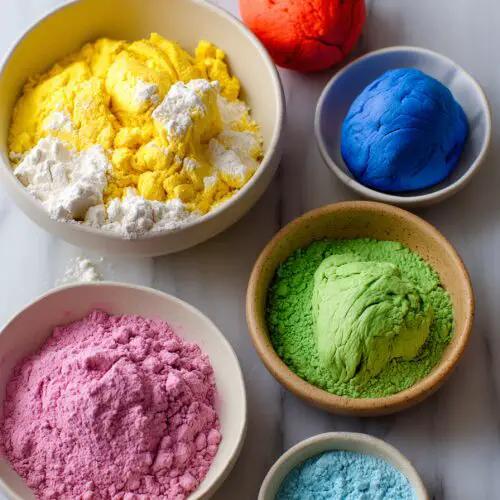
Playdough Recipe Without Cream Of Tartar
A soft, stretchy stovetop playdough made without cream of tartar, using only simple pantry ingredients like flour, salt, baking powder, oil, and vinegar or lemon juice. Easy to customize with colors and scents, budget-friendly, and kid-safe for sensory play.
Ingredients
- 2 cups all-purpose flour spooned and leveled
- 1 cup fine table salt fine salt gives a smoother texture than coarse kosher salt
- 2 tablespoons baking powder helps mimic cream of tartar’s tenderizing effect
- 2 tablespoons vegetable oil canola, sunflower, or any neutral oil; avoid strong-flavored olive oil
- 1 1/2 cups water room temperature or slightly warm
- 2 tablespoons white vinegar or lemon juice vinegar for neutral scent; lemon juice for a light citrus aroma
- food coloring gel or liquid, as desired; gel gives brighter color with less liquid
- 1 teaspoon glycerin optional, for extra shine and stretch
- 1 teaspoon vanilla, peppermint, or lemon extract optional, for a fun scent
- 1 tablespoon cocoa powder optional, 1–2 tablespoons for brown “chocolate” playdough; not for eating
Instructions
- In a medium bowl, whisk together the all-purpose flour, fine table salt, and baking powder until evenly combined. This helps prevent lumps and makes smoother playdough.2 cups all-purpose flour, 1 cup fine table salt, 2 tablespoons baking powder
- In a large nonstick saucepan, add the water, vegetable oil, and white vinegar or lemon juice. Stir to blend. If using glycerin or an extract for scent, add them now and stir to combine.2 tablespoons vegetable oil, 1 1/2 cups water, 2 tablespoons white vinegar or lemon juice, 1 teaspoon glycerin, 1 teaspoon vanilla, peppermint, or lemon extract
- Slowly pour the dry ingredients into the saucepan, whisking or stirring as you go. The mixture should look like a thin pancake batter. Make sure there are no pockets of dry flour.2 cups all-purpose flour, 1 cup fine table salt, 2 tablespoons baking powder
- Place the pan over medium-low heat and stir continuously with a sturdy silicone spatula or wooden spoon, scraping the bottom and sides so nothing sticks or burns. The mixture will thicken from a paste to a soft, lumpy dough in about 3–5 minutes.
- Continue cooking until the dough pulls away from the sides of the pot and clumps around the spoon, forming a rough ball. It should look like very thick mashed potatoes and feel tacky but not runny. If it still feels like thick batter, cook for another minute, stirring constantly.
- Turn the warm dough out onto a clean countertop or silicone mat. Let it cool for 3–5 minutes, until it is warm but safe to handle.
- Knead the warm dough like bread, folding and pressing for 2–3 minutes until smooth and stretchy. If the dough feels sticky, knead in a teaspoon of flour at a time. If it feels dry or crumbly, knead in 1/2 teaspoon of oil at a time until it softens.
- Divide the smooth dough into 2–4 pieces, depending on how many colors you want. Keep the pieces you are not working with wrapped or covered so they do not dry out.
- For each piece, press a small well into the center and add a few drops of food coloring. Fold the dough over the color and knead until the color is evenly distributed, adding more drops as needed for brighter shades. If using cocoa powder or dry spices, knead them in at this stage, adding a splash of water if needed to maintain a soft texture.food coloring, 1 tablespoon cocoa powder
- Let the colored dough balls cool completely at room temperature. Once cool, they are ready for play or can be stored in airtight containers or zip-top bags.
Notes
Storage: Store cooled playdough in airtight containers or zip-top bags at room temperature for up to 2 weeks, or in the refrigerator for 3–4 weeks. For longer storage, freeze tightly wrapped portions for up to 2 months and thaw overnight in the fridge, then bring to room temperature and knead until smooth.
Reviving: If dough becomes dry or crumbly, knead in a few drops of oil or 1/4 teaspoon water at a time until soft again. Sticky dough is usually undercooked or too wet—knead in extra flour a tablespoon at a time or return to the pot and cook briefly.
Safety: Made with common kitchen ingredients and non-toxic, but very salty and not intended as food. Supervise young children and discourage eating. High salt content also helps preserve the dough.
Tips: Nonstick or well-seasoned pans make cleanup easier. Cook fully to avoid sticky dough. For toddlers who taste everything, keep the salt (to discourage big bites) but skip food-like scents such as strong peppermint. You can bake thin shapes at 200°F (93°C) for 1–2 hours to harden them like salt dough ornaments.
Reviving: If dough becomes dry or crumbly, knead in a few drops of oil or 1/4 teaspoon water at a time until soft again. Sticky dough is usually undercooked or too wet—knead in extra flour a tablespoon at a time or return to the pot and cook briefly.
Safety: Made with common kitchen ingredients and non-toxic, but very salty and not intended as food. Supervise young children and discourage eating. High salt content also helps preserve the dough.
Tips: Nonstick or well-seasoned pans make cleanup easier. Cook fully to avoid sticky dough. For toddlers who taste everything, keep the salt (to discourage big bites) but skip food-like scents such as strong peppermint. You can bake thin shapes at 200°F (93°C) for 1–2 hours to harden them like salt dough ornaments.
Love this recipe?Follow us at @thenandnowspace for more