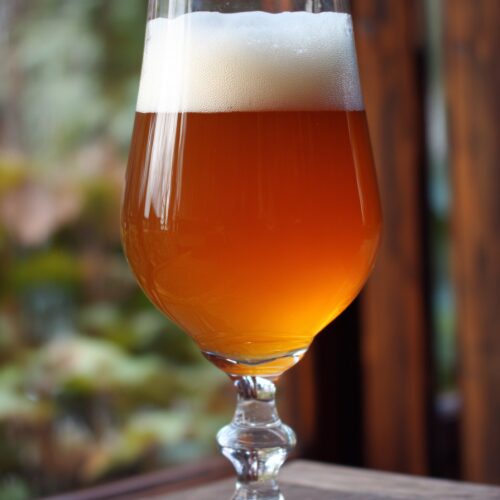
Einbecker Mai Urbock Homebrew (Maibock Lager)
A strong, golden German Maibock/Einbecker-style lager with deep bready malt, gentle noble hop character, and a clean, crisp finish. Designed for a 5-gallon (19 L) all-grain batch with extract alternatives included.
Ingredients
- 10 lb German Pilsner malt Weyermann or Bestmalz preferred; clean, bready base malt
- 3 lb German Vienna malt adds toasty, cracker-like maltiness
- 1 lb German Munich malt (light) boosts rich bread crust notes
- 0.25 lb Caramunich I around 30–40L; adds light caramel depth and head retention
- 6.6 lb light Pilsner liquid malt extract EXTRACT VERSION: late addition if possible for better color
- 2 lb Munich liquid malt extract EXTRACT VERSION
- 0.5 lb Caramunich I EXTRACT VERSION: steep at 150–155°F (65–68°C) for 20–30 minutes before the boil
- 1.25 oz Hallertau Mittelfrüh hops about 4% AA; 60-minute bittering addition
- 0.5 oz Tettnang hops about 4% AA; 20-minute flavor addition
- 0.5 oz Hallertau Mittelfrüh hops 10-minute aroma addition
- 2 packs Wyeast 2124 Bohemian Lager or 2 packs WLP830 German Lager or 2 packs SafLager W-34/70; make a 2–3 L starter for liquid yeast
- Yeast nutrient add with 20-minute hop addition, per manufacturer’s rate
- Whirlfloc or Irish moss add with 20-minute hop addition, per manufacturer’s rate
- Brewing water about 4 gallons (15 L) strike water plus sparge to collect ~6.5 gallons (24.5 L) pre-boil; use carbon-filtered, low-bicarbonate water
- Water salts (optional) aim for Ca 40–60 ppm, sulfate 40–60 ppm, chloride 50–70 ppm; adjust cautiously
- Oxygen shake fermenter vigorously or use pure O₂ with a diffusion stone for 45–60 seconds
Instructions
- Weigh and crush all-grain malts (Pilsner, Vienna, Munich, Caramunich I) to a medium crush with husks mostly intact. Avoid an overly fine crush to reduce the risk of a stuck sparge. For the extract version, skip milling and plan to steep the specialty Caramunich I later.10 lb German Pilsner malt, 3 lb German Vienna malt, 1 lb German Munich malt (light), 0.25 lb Caramunich I, 0.5 lb Caramunich I
- Heat about 4 gallons (15 L) of strike water to approximately 163°F (73°C). Add the crushed grain while stirring to prevent dry pockets. Stabilize the mash at 150–152°F (65–67°C) to balance fermentability and malt body.10 lb German Pilsner malt, 3 lb German Vienna malt, 1 lb German Munich malt (light), 0.25 lb Caramunich I, Brewing water
- Hold the mash at 150–152°F (65–67°C) for 60–75 minutes. Stir once or twice during the rest. Optionally check conversion with an iodine test, or simply give it the full 75 minutes.
- For extra malt depth and a rounder mouthfeel, raise the mash temperature to 158°F (70°C) for 10–15 minutes at the end of the main rest using boiling water or gentle heat if your system allows.
- Raise the mash to about 168°F (76°C) for 10 minutes if possible, then vorlauf until the runnings are mostly clear. Collect wort into the kettle while gently sparging with 168°F (76°C) water until you have about 6.5 gallons (24.5 L) of pre-boil wort or your system’s normal pre-boil volume.Brewing water
- For the extract version, steep 0.5 lb (227 g) Caramunich I in about 2.5–3 gallons (9.5–11.5 L) of water at 150–155°F (65–68°C) for 20–30 minutes, then remove the grains. Bring to a near boil, then add Munich LME and part of the Pilsner LME. Reserve some Pilsner LME for late addition (last 10–15 minutes) to keep color lighter.6.6 lb light Pilsner liquid malt extract, 2 lb Munich liquid malt extract, 0.5 lb Caramunich I
- Bring the wort to a strong rolling boil and boil for 90 minutes to drive off DMS and build malt richness. At 60 minutes remaining, add 1.25 oz (35 g) Hallertau Mittelfrüh hops. At 20 minutes remaining, add 0.5 oz (14 g) Tettnang hops along with yeast nutrient and Whirlfloc/Irish moss. At 10 minutes remaining, add the final 0.5 oz (14 g) Hallertau Mittelfrüh hops. For extract, add any reserved late-addition Pilsner LME with 10–15 minutes left in the boil, stirring well.6.6 lb light Pilsner liquid malt extract, 1.25 oz Hallertau Mittelfrüh hops, 0.5 oz Tettnang hops, 0.5 oz Hallertau Mittelfrüh hops, Yeast nutrient, Whirlfloc or Irish moss
- At the end of the boil, chill the wort rapidly to 46–50°F (8–10°C) using an immersion or plate chiller. Minimize exposure to air and potential contaminants. Once chilled, transfer the wort to a sanitized fermenter, leaving most of the trub behind.
- Oxygenate the chilled wort thoroughly. Either shake or rock the fermenter vigorously for several minutes, or inject pure O₂ through a sanitized diffusion stone for about 45–60 seconds to ensure a healthy fermentation for this higher-gravity lager.Oxygen
- Pitch a large, healthy amount of lager yeast at 46–50°F (8–10°C). Use a well-built 2–3 L starter for liquid yeast or pitch two properly rehydrated packs of dry yeast (e.g., SafLager W-34/70). Ferment at 48–52°F (9–11°C) for about 7–10 days, keeping temperature as steady as possible.2 packs Wyeast 2124 Bohemian Lager
- When fermentation is nearly complete (about 5–8 specific gravity points above your expected final gravity of 1.012–1.014), raise the temperature gradually to 60–62°F (15–17°C). Hold at this temperature for 2–3 days to allow the yeast to clean up diacetyl and other off-flavors.
- After the diacetyl rest, gradually reduce the temperature by about 3–5°F (2–3°C) per day until you reach 34°F (1°C). Lager the beer at this temperature for at least 4 weeks and up to 8 weeks. This extended cold conditioning will smooth the flavor, drop out haze, and refine the classic Maibock profile.
- Once lagering is complete and the beer is clear and stable, package into a keg or bottles. If kegging, carbonate to about 2.3–2.5 volumes of CO₂ for a lively but not overly fizzy beer. If bottling, add priming sugar as usual, then condition the bottles at 65–70°F (18–21°C) for 2–3 weeks before chilling.
- Serve the Einbecker-style Maibock at 45–48°F (7–9°C) in a clean glass. Expect a tight white head, deep golden color, and aromas of fresh bread, light honey, and gentle floral noble hops. Sip slowly and enjoy.
Notes
Batch size: 5 gallons (19 L) finished beer. Target OG: 1.066–1.068. Target FG: 1.012–1.014. Approx. ABV: 7.0–7.2%. IBU: ~28–32 using noble hops (Hallertau, Tettnang, or similar). Keep specialty malts restrained for a clean, layered malt profile rather than heavy caramel. Water: use carbon-filtered, low-bicarbonate water and moderate mineral additions for Ca 40–60 ppm, sulfate 40–60 ppm, chloride 50–70 ppm. Pitch rate and temperature control are critical for a clean lager: avoid under-pitching, keep a strong rolling boil to drive off DMS, and allow at least 4 weeks of lagering for best results. This beer ages well for 3–6 months cold, gradually developing a rounder, honeyed character.
Nutrition
Calories: 210kcal
Love this recipe?Follow us at @thenandnowspace for more