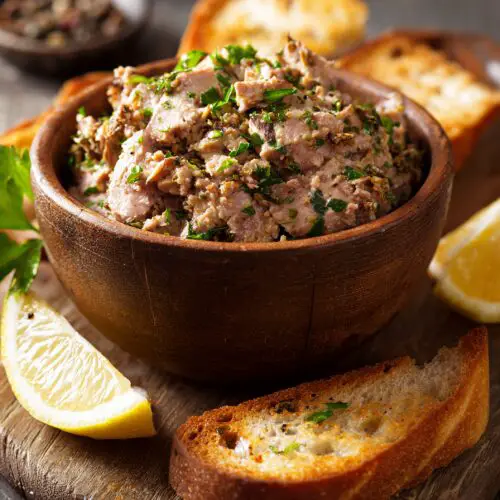
Chopped Liver
This traditional Jewish chopped liver recipe uses chicken livers, sweet caramelized onions, and hard-boiled eggs to create a rich, savory spread that’s perfect on rye, challah, or matzo. Classic deli-style flavor, naturally gluten-free and dairy-free (if you skip the butter), and ideal as a make-ahead appetizer for Jewish holidays or any time you want a nostalgic, protein-packed snack.
Ingredients
- 1 pound chicken livers trimmed of visible fat and any green spots; pat very dry
- 3 tablespoons schmaltz rendered chicken fat; or use neutral oil such as avocado or canola, divided
- 2 tablespoons unsalted butter optional; skip for kosher meat meals
- 2 large yellow onions thinly sliced (about 3 cups); sweet onions also work
- 2 cloves garlic minced; optional but recommended
- 3 large hard-boiled eggs peeled and cooled
- 1 to 1 1/2 teaspoons kosher salt plus more to taste, divided
- 1/2 teaspoon freshly ground black pepper
- 1/2 teaspoon sweet paprika Hungarian or regular; smoked paprika can be used for a twist
- 1 to 2 tablespoons chicken stock or water only if needed for smoother blending
- 1 to 2 tablespoons schmaltz or olive oil optional, for adjusting texture
- chopped fresh parsley optional, for garnish
- thinly sliced scallions or chives optional, for garnish
Instructions
- Place the chicken livers on a cutting board and trim away any visible fat, connective tissue, or greenish spots. Pat very dry with paper towels so they brown instead of steam. Cut any very large pieces in half so they cook evenly.1 pound chicken livers
- In a large skillet, heat 2 tablespoons schmaltz (or neutral oil) over medium heat. Add the sliced onions and a pinch of salt. Cook, stirring often, for 15–20 minutes, until the onions are soft, golden, and lightly caramelized. Lower the heat if they start browning too quickly.3 tablespoons schmaltz, 2 large yellow onions, 1 to 1 1/2 teaspoons kosher salt
- Stir the minced garlic into the onions and cook for about 1 minute, just until fragrant. Scrape the onion–garlic mixture into a bowl and set aside. Do not wash the pan.2 cloves garlic, 2 large yellow onions
- In the same skillet, add the remaining 1 tablespoon schmaltz and the butter (if using). Raise the heat slightly to medium-high. Add the chicken livers in a single layer, without crowding; cook in two batches if necessary. Sear for about 3–4 minutes per side, until the outsides are browned and the centers are just barely pink (about 165°F at the thickest part). Do not overcook.1 pound chicken livers, 3 tablespoons schmaltz, 2 tablespoons unsalted butter
- While the livers are still in the pan and warm, sprinkle with about 1 teaspoon kosher salt, the black pepper, and the sweet paprika. Toss gently to coat so the seasoning absorbs into the warm livers.1 to 1 1/2 teaspoons kosher salt, 1/2 teaspoon freshly ground black pepper, 1/2 teaspoon sweet paprika
- Transfer the seasoned livers to a large bowl or the bowl of a food processor and let cool for 10–15 minutes. They should be warm but not steaming hot before you add the eggs.1 pound chicken livers
- Add the caramelized onions and garlic to the bowl with the livers. Add the hard-boiled eggs (roughly chopped if you like). Taste a small bite of onion and liver together and adjust the salt and pepper slightly if needed at this stage.2 large yellow onions, 2 cloves garlic, 3 large hard-boiled eggs, 1 to 1 1/2 teaspoons kosher salt, 1/2 teaspoon freshly ground black pepper
- For a rustic chopped liver, transfer everything to a cutting board and chop together with a large knife or mezzaluna until finely chopped but still slightly chunky. For a smoother pâté-style spread, pulse the mixture in a food processor 6–10 times, scraping down the sides as needed. For extra smoothness, add 1–2 tablespoons chicken stock or water and 1–2 teaspoons additional schmaltz or olive oil while processing.1 to 2 tablespoons chicken stock or water, 1 to 2 tablespoons schmaltz or olive oil
- Taste a small spoonful. It should be savory, gently sweet from the onions, and well-seasoned but not overly salty. Add more salt, pepper, or paprika as needed. If the flavor tastes flat, a pinch of salt and another teaspoon of schmaltz can brighten it.1 to 1 1/2 teaspoons kosher salt, 1/2 teaspoon freshly ground black pepper, 1/2 teaspoon sweet paprika, 1 to 2 tablespoons schmaltz or olive oil
- Transfer the chopped liver to a serving bowl or storage container. Smooth the top and cover tightly. Chill in the refrigerator for at least 2 hours, preferably overnight, to allow the flavors to develop and the texture to firm for easy spreading.
- Before serving, let the chopped liver sit at room temperature for 15–20 minutes so it’s not ice-cold. Garnish with chopped fresh parsley and/or sliced scallions or chives and a light dusting of paprika if you like. Serve with matzo, rye or pumpernickel bread, crackers, sliced cucumbers, pickles, or crisp lettuce leaves.chopped fresh parsley, thinly sliced scallions or chives, 1/2 teaspoon sweet paprika
Notes
Don’t overcook the livers—aim for just done with a faint blush in the center to avoid a chalky texture and strong taste. Take your time caramelizing the onions; their sweetness balances the liver. Adjust the texture to your preference: chunky and rustic or smooth and pâté-like. Salt and liver flavors concentrate as the mixture chills, so season a bit lightly at first if you’re making it ahead, then fine-tune right before serving. For guests who are unsure about liver, present it as a ‘Savory Chicken Liver Spread’ on a board with colorful vegetables, crackers, and toast points.
Nutrition
Calories: 220kcal
Love this recipe?Follow us at @thenandnowspace for more